
Last updated: 8 February 2026
AI SEO in 2026: Adapting to the Era of Answer Engines
Artificial intelligence is now firmly embedded in how people search. As we move through 2026, many business owners across the UK (and beyond) are asking the same question:
Where is our traffic actually going to come from?
Search today looks nothing like it did a few years ago. We’re no longer just typing short keywords into a box and scrolling through blue links. People are having conversations with search engines, asking complex questions, and expecting clear, summarised answers immediately.
That shift has created understandable anxiety. Is the “ten blue links” era over? Is AI going to replace websites entirely?
From what I see day-to-day working with UK businesses, the mechanics of search have changed — but the fundamental need for trust, expertise, and real-world validation hasn’t.
In this post, I’ll break down how I approach SEO in an AI-first world, what actually matters in 2026, and how to adapt without chasing hype or short-term tactics.
Google Is an Answer Engine Now (and What That Means for CTR)
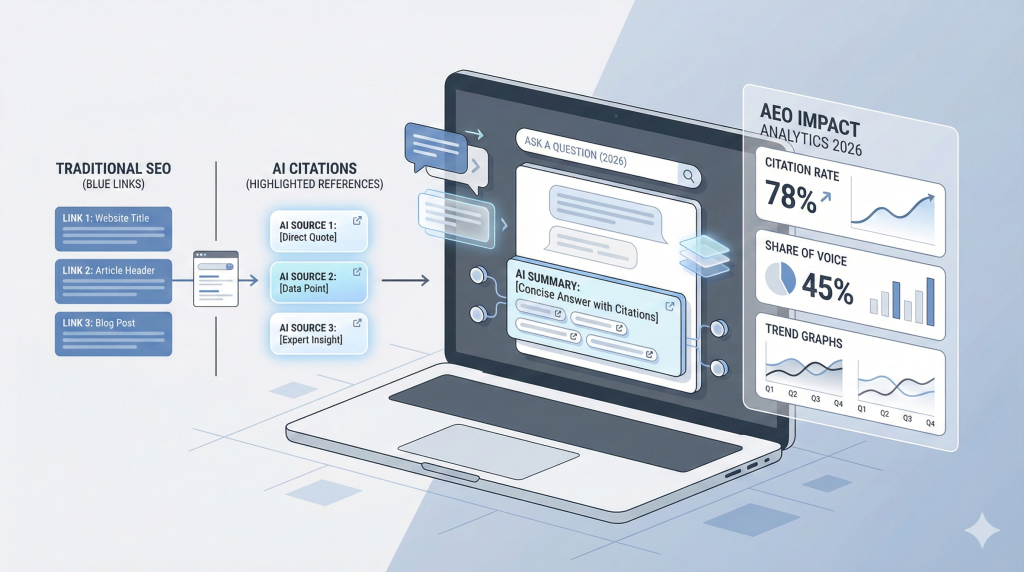
By 2026, Google — along with platforms like ChatGPT Search and Perplexity — has effectively become an answer engine rather than a pure traffic router.
Its goal is no longer just to send users to websites. In many cases, it aims to satisfy the query immediately inside the interface.
That’s where concerns about “zero-click searches” come from — and yes, for simple informational queries, click-through rates have declined.
If your content answers a question that can be summarised in two sentences, the AI will likely take that traffic.
But this also clarifies strategy.
AI struggles with nuance, experience, and context. That’s where opportunity still exists.
Instead of targeting basic definition-style queries, the focus needs to shift to:
- Complex questions that require judgement or experience
- Localised UK-specific insight
- Practical validation rather than theory
Traffic volume alone is no longer the metric. Engagement quality and conversion intent matter far more.
E-E-A-T Is Your Defence Against Mass-Produced Content
A few years ago, many assumed they could publish large volumes of AI-written content and win.
That approach simply doesn’t work in 2026.
Search systems are now extremely good at identifying low-effort, generic content — regardless of whether it was written by a human or an AI.
What Google continues to prioritise is E-E-A-T:
- Experience
- Expertise
- Authoritativeness
- Trustworthiness
For UK businesses, experience is the hardest thing for AI to fake.
An AI can explain how to fix a leak. It can’t explain what usually goes wrong in a Victorian terrace in Leeds.
First-hand experience, original photos, real examples, and location-specific insight all act as credibility signals — not just for users, but for AI systems deciding what to cite.
Local SEO Has Shifted Toward Entity & Context
For local businesses, SEO in 2026 is less about keywords and more about entity confidence.
When someone asks:
“Find me a reliable electrician near Bristol who’s available today.”
Google isn’t just checking your website.
It’s cross-referencing:
- Your Google Business Profile
- Opening hours and availability
- Service consistency across the web
- Reviews and sentiment
If your data doesn’t align, the AI hesitates — and hesitation means you don’t get shown.
This is why consistency across listings, your website, and third-party platforms is no longer “best practice” — it’s foundational.
Conversational Queries Are Driving Intent
Search queries are now longer, more specific, and far more natural.
Instead of:
“holiday cottages”
Users ask:
“What’s the best seaside cottage in Cornwall for a family with two dogs in August?”
If your content only targets short, generic phrases, you’re competing with every aggregator on the web.
If you answer real questions in natural language — the same way customers ask them — you give AI systems something useful to work with.
If your copy doesn’t sound like how you’d speak to a customer, rewrite it.
Technical Performance Is Now a Trust Signal
AI systems are expensive to run. They prioritise sites that are fast, clean, and easy to render.
Beyond crawl efficiency, user frustration matters.
If users land on your site and immediately struggle — slow load times, intrusive pop-ups, poor mobile experience — that reflects badly on the platform that recommended you.
By 2026, user frustration is a ranking signal — even if it’s not explicitly named as one.
Fast, usable websites protect both your visibility and Google’s reputation.
The Verdict: Be More Human, Not More Automated
You don’t need to become an AI expert or chase every new tool.
You need to:
- Show real experience
- Be locally relevant
- Make information easy to understand
- Provide a smooth user experience
In a world full of generic, auto-generated content, genuine expertise stands out more than ever.
That’s how you win visibility in answer engines — not by gaming systems, but by being genuinely useful.
If you want to understand how AI is currently interpreting your site, your content, or your local presence, I’m always happy to talk it through.