ChatGPT Isn’t Replacing Google — It’s Filtering Search Before It
Last updated: 12 January 2026
There’s a growing assumption in SEO that traffic is declining because users are leaving Google and moving to AI tools like ChatGPT. Based on what I’m seeing across real sites and real data, that conclusion doesn’t hold up.
What is happening is more subtle — and more important.
AI tools are increasingly being used as a filtering step in the search journey, helping users clarify their intent before they return to Google to complete an action.
How Search Behaviour Is Actually Changing
In 2026, the search journey rarely starts and ends in one place.
A common pattern now looks like this:
- A user asks a broad or uncertain question in an AI tool like ChatGTP
- The AI summarises options
- The user forms a clearer intent and searches in the AI tool for further information
- They return to Google to validate, compare, or act
- They return to the AI tool to compare the brans/website they filter down too
- They return to Google to complete the website action
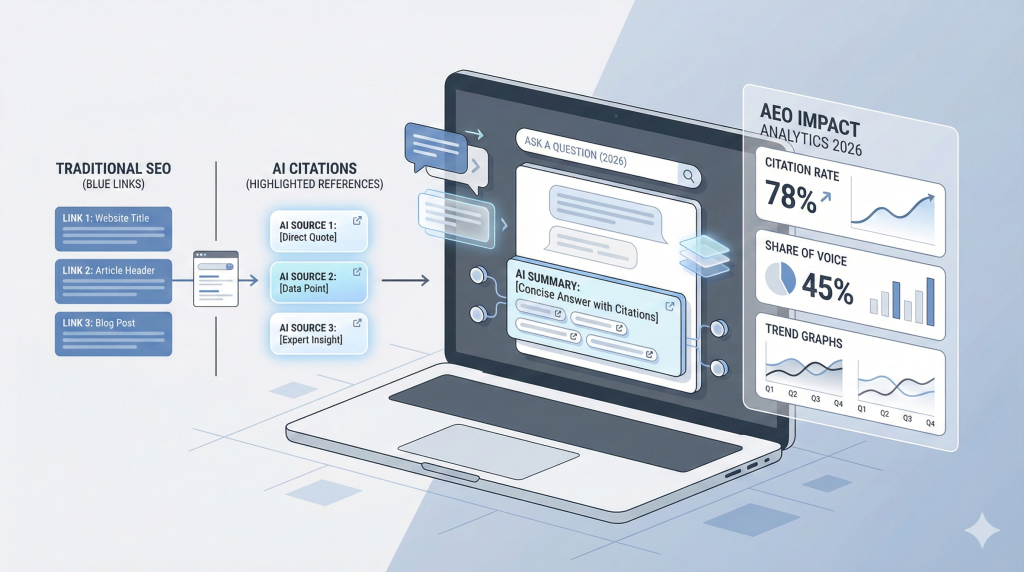
AI isn’t replacing search engines — it’s shaping how users gather more information more quickly.
Why This Matters for SEO
This shift explains several trends that confuse people when they look only at surface-level metrics:
- Impressions are increasing while clicks decline
- Rankings holding steady while blog traffic drops
- Branded searches are rising despite lower informational traffic
If a user uses AI tools to shortlist solutions, brands, or approaches, they may never click the original informational result — even though that content influenced the outcome.
Instead, they return to Google with a much more specific query:
- A brand name
- A product comparison
- A service + location
- A commercial or transactional phrase
From an analytics perspective, that can look like lost traffic. In reality, it’s a compressed intent.

AI as a Pre-Search Filter, Not a Destination
AI tools are increasingly used to:
- Remove irrelevant options
- Clarify terminology
- Summarise categories
- Shortlist brands or approaches
Once that filtering is done, users still tend to rely on Google today to:
- Check legitimacy
- Compare providers
- Read reviews
- Confirm pricing or availability
- Take action
This behaviour may evolve as AI search becomes more transactional, but for now, Google continues to act as the confirmation and execution layer in the journey.
What Happens If This Changes?
It’s essential to be clear: the current behaviour is not guaranteed to remain permanent.
If AI systems become more trusted, more transactional, and more tightly integrated with payments, bookings, and identity, we could see a future where fewer searches return to Google at all.
In that scenario:
- AI tools may handle comparisons end-to-end
- Brand discovery and validation may happen entirely within AI interfaces
- Click-based traffic could decline further
- Visibility becomes more about inclusion than ranking
Even in that future, the fundamentals don’t disappear.
AI systems still rely on:
- Credible websites
- Clear brand signals
- Structured, factual content
- Real-world trust indicators
The difference is where influence is measured, not whether it exists.
The Evolving Search Journey
Phase 1: Traditional Search (Pre-2023)
User searches Google → clicks an organic result → reads content → converts
Phase 2: Assisted Search (2023–2025)
- Featured snippets and SERP features reduce clicks
- Content influences decisions without a visit
Phase 3: Filtered Search (2025–2026)
- AI tools shape early understanding
- Google captures refined, high-intent searches
- Conversions occur later in the journey
Phase 4: Possible Future State
- AI handles discovery, comparison, and shortlisting
- Brands win by being referenced, not clicked
Regardless of how far this shift goes, SEO remains the foundation feeding every stage.
Final Thoughts
AI tools are not stealing traffic from Google.
They’re changing how people decide what to search for when they get there.
It’s more important than ever to be mentioned or seen in all channels.
SEO still matters — but it now works earlier, quieter, and across more touchpoints than a single click ever showed.
If you’d like to talk through how AI-assisted search is affecting your visibility — or how your content supports decisions before the click — I’m always happy to chat.

Paul Gordon
Paul Gordon is an SEO and AI Search Visibility Consultant with 18+ years of experience helping brands improve how they are understood, ranked and recommended across Google and AI systems. He specialises in SEO, AI Search Optimisation and Entity Building, working directly with businesses to strengthen their visibility, authority and digital identity.
Subscribe to our weekly newsletter
Search is evolving faster than ever. With AI reshaping user behaviour and discovery pathways, traditional SEO has become just one part of a much bigger picture: Search Optimisation. This blog breaks down the trends and tactics that actually move the needle — based on experience, testing, and real results.