Last updated: 19 February 2026
Modern AI-driven search doesn’t evaluate a business through isolated pages or single keywords. It evaluates meaning across a decision journey. Visibility is earned layer by layer — and conversion visibility is always earned upstream.
This is a framework you can apply to any type of business — local services, e-commerce, multi-location organisations, B2B providers, clinics, trades, and everything in between.
The central idea is simple: modern search is interpretive, not mechanical. AI systems try to understand what a person is actually going through, what they’re trying to solve, and what would make a recommendation “safe” and reliable.
That means performance depends less on “optimising pages” and more on aligning your business with the full journey your customers go through before they commit.
The six-layer alignment model
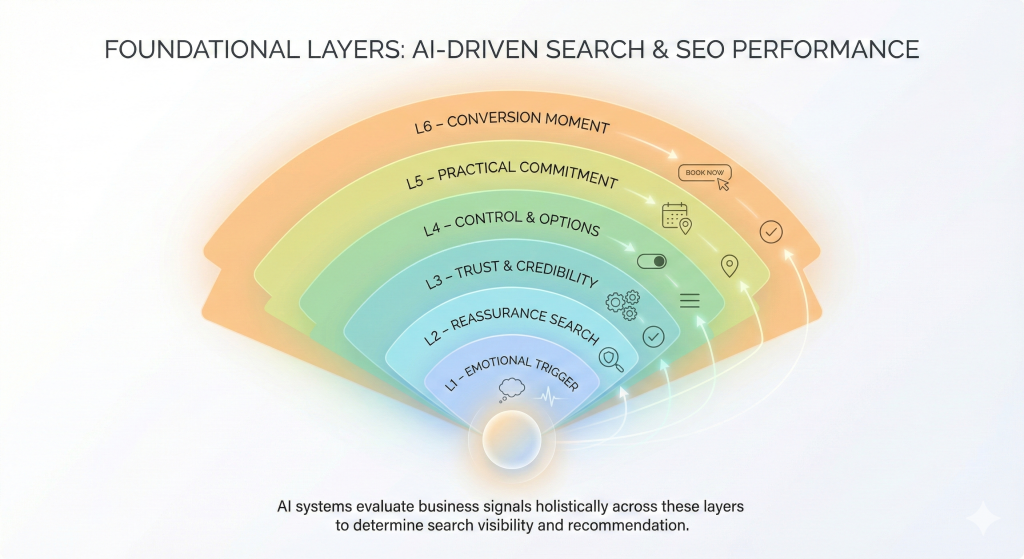
Below are the six foundational layers businesses must align with to perform well in AI-driven search systems.
Each layer represents a different stage of real human decision-making. AI systems see these layers through language, behaviour, signals, and consistency across the web — not just what’s written on a single page.
L1 – Emotional Trigger
What this represents in human decision-making
This is the moment something becomes a problem. It’s often emotional: worry, uncertainty, frustration, embarrassment, urgency, or fear. People don’t start with “best provider near me” — they start with what they’re feeling.
What AI systems see at this stage
AI sees broad, emotion-led questions and early-stage uncertainty. It also sees whether businesses acknowledge real concerns in a credible, human way.
Why this layer matters for visibility and recommendations
If your business doesn’t align with the emotional reality of the user, you can be filtered out before a “near me” search even happens. Recommendation eligibility starts here.
What businesses often get wrong
They jump straight to selling. They write generic copy that avoids emotion. They assume people are logical at the start of the journey when they’re often not.
What alignment looks like when done well
Clear, calm, human language that reflects real customer feelings. Content and messaging that makes the user feel understood before they feel persuaded.
If your messaging only makes sense to someone who is already ready to buy, you’re invisible in the stage where most journeys actually begin.
L2 – Reassurance Search
What this represents in human decision-making
Once the emotional trigger is acknowledged, people look for reassurance. They want to know: “Is this normal?”, “Is there a safe way forward?”, “Do people like me get good outcomes?”
What AI systems see at this stage
Natural-language questions that seek reassurance, explanation, and safety. AI also evaluates whether the business communicates without pressure, exaggeration, or vague claims.
Why this layer matters for visibility and recommendations
AI systems tend to favour sources that reduce uncertainty. If you can reassure with clarity and experience-backed guidance, your visibility improves across early and mid-funnel prompts.
What businesses often get wrong
They publish content that’s too generic, too thin, or too “marketing-led”. They avoid specifics, which makes them sound less trustworthy.
What alignment looks like when done well
Helpful explanations. Clear expectations. Real-world context. Straight answers that make the next step feel safe and manageable.
L3 – Trust & Credibility
What this represents in human decision-making
This is where the user asks: “Who can I trust?” They may be closer to action now, but they won’t commit until credibility feels real.
What AI systems see at this stage
AI evaluates consistency across your presence: reviews, third-party mentions, profiles, policies, credentials, expertise signals, and whether your story matches across platforms.
Why this layer matters for visibility and recommendations
AI recommendation systems are risk-averse. If trust signals are weak or contradictory, the AI will hedge — and hedging usually means you don’t get recommended.
What businesses often get wrong
They assume trust is “a website thing”. They treat reviews as an afterthought. They have inconsistent messaging across web listings, profiles, and service pages.
What alignment looks like when done well
Clear proof, consistent facts, strong review narratives, credible third-party presence, and an online footprint that reinforces the same identity everywhere.
Trust is no longer a nice-to-have. In AI search, it’s the cost of entry for recommendation eligibility.
L4 – Control & Options
What this represents in human decision-making
People want to understand what happens next. They look for control: choices, boundaries, process, and what they can expect. This is where uncertainty turns into decision confidence.
What AI systems see at this stage
Questions around processes, options, comparisons, and “what if” scenarios. AI also looks for whether businesses explain outcomes and trade-offs clearly.
Why this layer matters for visibility and recommendations
Businesses that explain options well are easier for AI to summarise and recommend. When information is missing or unclear, AI has less confidence presenting that business as the “right fit”.
What businesses often get wrong
They hide important details behind vague promises. They avoid specifics. They make everything sound the same, which removes differentiation.
What alignment looks like when done well
Clear explanation of how things work, what choices exist, who each option is for, and what a customer can expect at each step.
L5 – Practical Commitment
What this represents in human decision-making
The user is close, but now reality kicks in: cost, timelines, availability, location, logistics, delivery, returns, scheduling, payment, contracts.
What AI systems see at this stage
Questions about pricing, availability, lead times, stock, booking, service areas, and practical constraints. AI also evaluates whether information is easy to find and consistent.
Why this layer matters for visibility and recommendations
AI systems often push users toward the easiest next step. If your business is hard to understand or difficult to act on, you lose recommendations to businesses that reduce friction.
What businesses often get wrong
They hide prices, obscure availability, make policies hard to find, or create uncertainty through unclear service areas and vague next steps.
What alignment looks like when done well
Practical clarity: transparent expectations, easy pathways, clear logistics, and a low-friction route to the next step.
Friction doesn’t just reduce conversions — it reduces recommendation confidence.
L6 – Conversion Moment
What this represents in human decision-making
This is the final step: booking, enquiry, purchase, consultation, call, quote request, checkout. At this point the user wants certainty and speed.
What AI systems see at this stage
AI evaluates whether the business appears reliable at the point of action: consistent details, clear CTAs, fast pages, easy booking, strong proof, and minimal confusion.
Why this layer matters for visibility and recommendations
AI systems don’t want to send users to dead ends. Conversion visibility is often reserved for businesses that have already earned confidence across earlier layers.
What businesses often get wrong
They over-invest in “conversion pages” while ignoring upstream alignment. They assume strong CTAs fix weak trust. They treat conversion as a page-level issue rather than a journey-level outcome.
What alignment looks like when done well
Fast, clear, low-friction conversion paths that match what the user has been promised throughout the journey.

How the layers work together
These layers aren’t a marketing funnel. They’re a representation of how real decisions form — and how AI systems interpret those decisions.
AI evaluates meaning across layers. If your business is missing alignment early on, you can lose visibility later — even if your “money page” is perfectly built.
That’s why this is not about “SEO tactics”. It’s about coherence.
And it’s why conversion visibility (L6) is earned upstream.
Final takeaway
Modern AI and SEO performance depends on layered alignment across the entire journey — not isolated optimisation at the point of conversion.
The businesses that win are the ones that communicate clearly, build trust consistently, and align with real-world intent at every stage of the decision process.
If you want to sanity-check how your business aligns across these six layers — and where you’re likely to be included or excluded in AI-driven recommendations — feel free to
get in touch
and we can talk it through.